
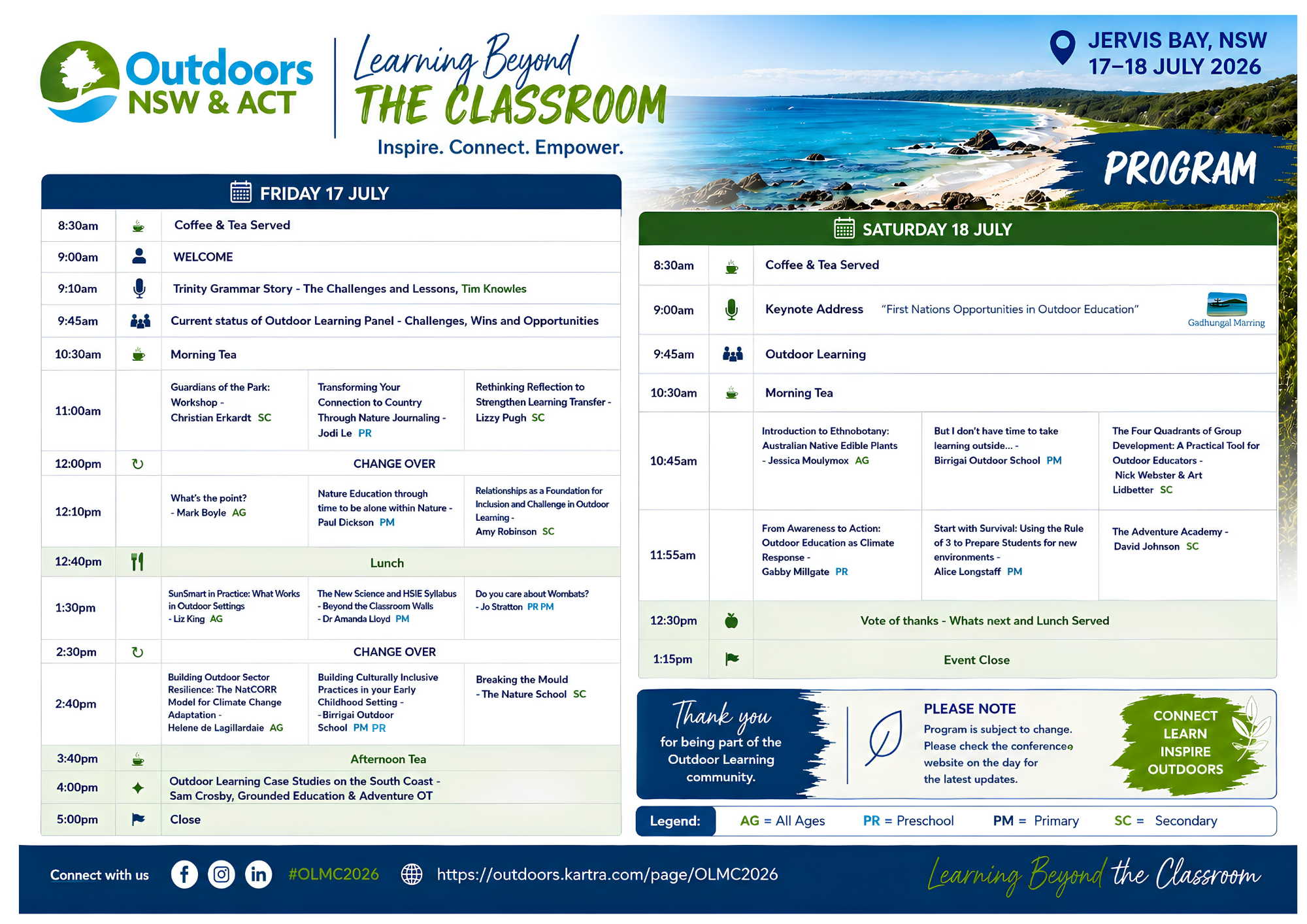
Outdoor Learning Conference Program 2026
Friday 17th & Saturday 18th July 2026
Trinity Grammar Field Studies Centre, Woollamia, Jervis Bay
TICKETS ON SALE
Attention: ONSWACT Members
book your tickets through your membership portal to get your discounts
SUPPORTED BY

If you are not currently a member of Outdoors NSW & ACT,
register to receive your ticket to get one year's subscriber access for free (valued at $25 per annum).
If you want to keep your subscriber access after 12 months, you will be billed at $25 per annum.
FRIDAY 11AM
Guardians of the Park - CHRISTIAN ECKARDT
How do we move young people beyond simply experiencing nature to actively caring for it? Guardians of the Park is a place-based outdoor learning program developed within Western Sydney Parklands that explores how repeated, immersive experiences in nature can support adolescents to build curiosity, ecological understanding and a sense of stewardship for local environments.
This practical workshop introduces a sequence of field-based activities used in the program to guide students from observation to inquiry and action. Participants will experience short activities that encourage noticing the landscape, identifying ecological relationships and asking questions about how natural systems function. From these observations, educators explore how students can begin to see themselves as caretakers of place, developing small stewardship responses grounded in the environments they encounter.
The session focuses on approaches that are intentionally low-resource and easily transferable to school grounds, parks and local natural areas. Through practitioner examples and hands-on participation, the workshop demonstrates how outdoor educators can scaffold curiosity, deepen environmental engagement and support students to develop a sense of responsibility for the places they learn within.
Transforming Your Connection to Country Through Nature Journaling - JODY LE
This workshop positions nature journaling as a reflective and transformative practice for both educators and staff teams. It explores how nature journaling can support educators to deepen their own Connection to Country through intentional noticing, wondering and developing an understanding of place.
Participants will engage in two place-based journaling experiences that emphasise observation and reflective thinking. Through these experiences, educators will build awareness of the richness and potential of their own learning environments, recognising the depth of insight that can emerge from slowing down and engaging with place. The workshop highlights how strengthening an educator’s personal Connection to Country enhances their capacity to interpret, respond to, and teach from place in meaningful and authentic ways.
Participants will also explore how nature journaling can be embedded within everyday practice across a range of educational settings and age groups. The session considers how sustained engagement in journaling enables educators to deepen reflective practice, informing and shaping the ongoing development of their nature pedagogy. Through hands on engagement and discussion, this workshop supports educators to confidently adopt nature journaling as an ongoing professional practice, both within their teams and alongside the children they work with.
Rethinking Reflection to Strengthen Learning Transfer - LIZZY PUGH
Through a series of short, active challenges and contrasting reflection approaches, we’ll examine how different facilitation choices shape engagement, student voice, and the transfer of learning beyond the experience.
Together, we’ll experiment with alternatives to traditional reflection — including movement-based processing, peer-led dialogue, silence, and metaphor — and consider when and how each approach can be most effective.
FRIDAY 12:10PM
What's the Point - MARK BOYLE
Nature Education through time to be alone within Nature - PAUL DICKSON
With his Nature Education experience in the education of children from 8 months to 18 years old, and adults to 85 yrs old, he educates through his own personal lived and learnt knowledge of ecology and ecosystems around NSW and Victoria. Nature is not a place to escape into, we come from Nature, we as individuals and communities have always been part of Nature.
Never try attempting to separate oneself from the natural world.
If one finds 3 × forty minute allocations of time in a favourite natural space in an easy drive / walk from home, many aspects of health and joy begin unfolding.
Relationships as a Foundation for Inclusion and Challenge in Outdoor Learning - AMY ROBINSON
Outdoor education can offer powerful opportunities for personal growth, yet some students remain hesitant to participate in camps, expeditions and outdoor learning experiences. Anxiety, neurodivergence, behavioural challenges and physical or mental health considerations can create barriers that make outdoor programs feel inaccessible for some students and their families.
This presentation explores how strong educator–student relationships can play a critical role in making outdoor learning more inclusive. When educators know their students well, they are better able to anticipate potential barriers and design programs that support participation from the outset. This might include adjusting aspects of a program before it is announced, communicating early with families, or planning supports that allow students to feel confident about participating.
At the same time, strong relationships can also enable meaningful challenge. When students trust the educator leading the experience, they are often more willing to attempt activities that initially feel difficult or intimidating. This trust can allow educators to maintain high expectations and authentic challenge while still supporting inclusion.
Drawing on experiences from school outdoor programs, this session will explore how knowing students well allows educators to both design inclusive programs and support students to push beyond their comfort zones.
Participants will be invited to reflect on how relationships, early communication with families and thoughtful program design can help create outdoor learning environments where more students feel able to participate while still experiencing meaningful challenge and growth.
FRIDAY 1:30PM
SunSmart in Practice: What Works in Outdoor Settings - LIZ KING
This interactive workshop will introduce participants to the SunSmart Workplace Sun Protection Toolkit and explore how it can be applied in real outdoor learning and outdoor work settings. Rather than focusing on the full toolkit, the session will draw on participants’ own experiences to identify common challenges and practical starting points. Through discussion or small group activities, participants will share ideas, test approaches, and consider how small, achievable actions can strengthen sun protection in their own organisations.
By the end of the workshop, participants will:
- Understand the purpose and key components of the SunSmart Workplace Sun Protection Toolkit
Identify common sun protection challenges in their own settings
Explore practical, realistic ways to get started, based on their organisation’s context
Gain ideas and insights that could inform future improvements to sun protection guidance for their industry
The New Science and HSIE Syllabus, Beyond the Classroom Walls - DR AMANDA LLOYD
The new syllabus era is here (again), with Science and HSIE K–6 rolling out across NSW schools. While there are significant shifts in HSIE and new concepts within Science, one constant remains, the power of outdoor learning to connect children authentically to the environments they are studying.
The workshop is delivered in two parts. The first provides a practical overview of the how, why and what of the new documents, exploring how to read them through an outdoor learning lens, with a particular focus on Tier 2 and Tier 3 vocabulary development.
We then move outdoors. Drawing on programs from Greater Sydney Parklands, participants will experience place-based approaches that support students to explore, observe and collect data in meaningful ways. Activities demonstrate how learning can grow from direct experience and extend into whole-systems thinking and environmental stewardship, directly aligned to the new syllabus.
This workshop is a practical, one-stop session for designing, delivering and strengthening outdoor learning using the new Science and HSIE syllabuses as the enabler.
Do You Care About Wombats? - JO STRATTON
This presentation examines a preschool classroom case study emerging from a long‑term inquiry project titled 'Do you care about wombats?' It explores how participation in the Birrigai Wombat Songlines program instigated rich outdoor learning opportunities that enabled children to develop a deeper connection to Country and fostered sustained curiosity about their local environment. Throughout the project, the educator team engaged in deep listening to the children’s thinking and ideas as they developed theories about the local wombat population. This inquiry ultimately led the children to take meaningful action to support the wombats and to share their knowledge with the wider community. Drawing on this case study, the session highlights the pedagogical value of integrating outdoor learning with place‑based education and culturally responsive practice. These approaches align with key Australian Professional Standards for Teachers by promoting respect for Aboriginal and Torres Strait Islander histories, cultures, and knowledge systems; supporting the design of engaging and developmentally appropriate learning experiences; and enabling the purposeful use of outdoor and experiential learning resources. The broader impact of outdoor learning programs is also considered, illustrating how such experiences can influence not only the children involved but also the wider community through strengthened connections to local environments and a shared responsibility to care for Country.
FRIDAY 2:40PM
Building Outdoor Sector Resilience: The NatCORR Model for Climate Change Adaptation - ELLIE HARGRAVE
Despite its scale and economic contribution, the outdoor sector remains highly diverse and geographically dispersed, with limited coordinated capacity to systematically understand, monitor, and mitigate evolving natural disaster risks. Whether this is for school excursions, outdoor camps or tourism adventures, NatCORR works to increase sector capacity in understanding climate change risk and incident response.
The National Centre for Outdoor Risk and Readiness (NatCORR), established in 2022 by Outward Bound Australia in response to the 2019–20 Black Summer bushfires, represents an innovative, sector-wide collaboration model designed to address this capability gap. NatCORR provides coordinated disaster preparedness, risk intelligence, and response support to outdoor providers across Australia, strengthening resilience at both organisational and sector levels.
This interactive session will focus on incident response, weather monitoring, and climate forecasting tools. Through a facilitated scenario exercise, attendees will apply climate forecasting data to inform risk assessment, operational decision-making, and activity planning. The session will explore practical strategies to minimise heat stress risk and enhance program resilience in the context of a changing climate.
Building Culturally Inclusive Practices into your Early Childhood Setting - BIRRIGAI OUTDOOR SCHOOL
Abstract pending
THE NATURE SCHOOL
Abstract pending
SATURDAY 10:45AM
Introduction to Ethnobotany: Australian Native Edible Plants - JESSICA MOULYNOX
Jessica Moulynox from Backyard Botany is a qualified Ethnobotanist and Forest Therapy Practitioner with over 20 years’ experience exploring and sharing the wonders of Australian native edible plants. She is also the author of her first book, A–Z of Botany, inspiring the next generation to connect with plants.
In this hands-on workshop, Jessica reveals the ways native edible plants can be used in your garden and why connecting people to them is so important. Participants discover a selection of native edible plants, their edibility, physiology and traits through engaging, interactive experiences (touch, taste, smell etc)
A key focus of the workshops is creating space for participants to learn about respectful reconciliation through ancient cultural plant knowledge and modern scientific understanding, encouraging cross-cultural knowledge sharing.
Whether reconnecting with the local landscape, or introducing native plant walks to programs, Jessica can help bring the magic of Australian plants to life.
'But I don't have time to take learning outside...' - BIRRIGAI OUTDOOR SCHOOL
Take the kids outside? Sure that would be nice, but how can I do that when my teaching is already time poor, the curriculum packed and besides, I've got two students who already spend most of play times sitting outside the office because of playground misdemeanours. I can't take them out!!
This hands-on workshop will pave the way for perceived challenges to become benefit-laden opportunities. Aimed at Primary School educators, we guarantee fun, plentiful ideas and a greater understanding of why taking learning outdoors can be a win-win situation for you and your students.
The Four Quadrants of Group Development - Nick Webster and Art Lidbetter
This presentation introduces an interactive framework for understanding and facilitating group development [stages] in outdoor education through the use of shared language and intentional habit formation. The framework provides educators and students with a clear pathway for increasing responsibility, autonomy, and group capability through a transparent tool that helps outdoor educators design programs that strengthen group dynamics, foster student ownership, and integrate behavioural science with experiential learning. Additionally, this approach allows instructors to communicate expectations, manage risk, and adapt activities as conditions change, while also creating repeated opportunities for students to practise responsibility and experience success.
SATURDAY 11:55AM
From Awareness to Action: Outdoor Education as Climate Response - GABBY MILLGATE
Australia’s first National Climate Risk Assessment confirms that climate impacts are already affecting communities, systems, and future generations—and that adaptation must be effective at local scales. Yet children are largely absent from this framing, despite being the group who will live with the consequences longest. This session responds directly to that gap—positioning education, and specifically outdoor education, as part of the immediate climate response.
This session positions outdoor educators as frontline contributors to climate adaptation. Drawing on Australia’s first National Climate Risk Assessment, participants will explore how local, everyday practice can respond to global challenges.
At the centre of the session is the Build Your Climate Strategy System—a simple, scalable framework that equips leaders to map, implement, and measure their contribution to climate adaptation. Educators will leave with ready-to-use tools that translate climate knowledge into action, building children’s resilience, agency, and ecological literacy through outdoor learning.
Participants will leave with:
• A take-home Build Your Climate Strategy System template to map their service or program’s contribution to climate adaptation
• Access to the Access to Nature Survey to measure impact and strengthen practice
• Practical, low-cost strategies to embed climate readiness into everyday outdoor learning
This session moves beyond awareness—into action.
It positions outdoor educators as essential, frontline contributors to Australia’s climate response.
If adaptation must happen locally—this is what it looks like in practice.
Start with Survival: Using the Rule of 3 to Prepare Students for new environments - ALICE LONGSTAFF
This interactive workshop draws on Alice's background in bushcraft, international expeditions, and operational leadership to show how survival principles can help students take on any challenge, find comfort in uncomfortable situations, and get both physically and mentally set up for success.
It will use the Rule of 3 in survival (3 minutes without oxygen, 3 hours without shelter, 3 days without water, 3 weeks without food) as a simple, easy-to-remember way to check if you and your group are ready before heading into new or challenging situations, looking at what these needs looked like in the past, and what they look like today in modern life. Participants will get hands-on, building a mini survival shelter for a 5cm “person” made from marshmallows, working in small groups under time and material limits. We’ll then introduce “surprises” like rain, wind, and missing resources to see how preparation affects comfort, confidence, and the ability to deal with challenges. Helping students experience firsthand the consequences of not being prepared, rather than just being told ‘bring your raincoat, it might rain.”
Finally, we’ll look at how instructors can move from reactive survival to proactive preparation, running simple Rule of 3 check-ins at the start of the day, before a challenge, camp or expedition. Using this principle again and again can help students (and staff) make it a habit: if they’re dry, prepared, fed, and watered, they’re in the best position to succeed, both physically and mentally, in whatever challenge comes next. In the outdoor industry, these challenges often push students out of their comfort zone, but with the right preparation, as we know, these moments become opportunities for growth, resilience, and confidence.
The Adventure Academy - DAVID JOHNSON
This session explores a ten-week experiential program run by Scots College for Year 9 boys.
It will showcase the learning outcomes from the program that could be adapted to any outdoor program. It doesn't have to cost money, as the mixture of stories, props and short videos of student and parent engagement will show. There will be plenty of scope for discussion and explanation of how we make this amazing program happen on a practical level.
BOOK YOUR TICKET
Outdoor Learning
Mini Conference
Not a mini event but still at a mini price to ensure access for all
outdoor educators
Members of Outdoors NSW & ACT need to book through your membership portal to get your $115 discount.

© Copyrights by Outdoors NSW & ACT Limited. ACN 657 112 260. All Rights Reseved.